



Office Storage for Small Spaces That Works
A cramped office usually shows up first in the wrong places – paperwork stacked on a return desk, stationery living in meeting rooms, bags tucked under workstations, and cables creeping across the floor. Good office storage for small spaces fixes more than visual clutter. It improves movement, protects workflow, and helps a compact fit-out feel deliberate rather than temporary.
For business buyers, the challenge is rarely just finding somewhere to put things. It is choosing storage that works hard without making the room feel tighter, darker, or harder to use. In small offices, home offices, reception back rooms, and shared admin zones, every storage decision affects circulation, access, cleaning, and the overall look of the space.
What small offices actually need from storage
In a compact footprint, storage has to earn its place. A bulky unit that holds plenty but blocks a walkway is not efficient. Nor is a stylish shelf that looks sharp in a product image but leaves files exposed and everyday items looking messy.
The best approach is to separate what needs fast access from what simply needs a home. Daily-use items such as active files, charging equipment, notebooks, and office consumables should sit close to desks and shared work points. Archive boxes, spare stock, and infrequently used equipment can move to higher shelving, under-desk units, or perimeter storage.
This is where commercial thinking matters. A small office does not need less planning than a large one. It needs more precision. Storage should support the actual rhythm of the workplace: who uses the area, how often items are accessed, and whether the room is client-facing or purely operational.
Office storage for small spaces starts with layout
Before choosing cabinets or drawers, look at the floor plan. Many storage problems are layout problems in disguise. If desks are oversized for the room, or positioned without regard for traffic flow, even excellent storage will feel awkward.
Start with the edges of the room. Wall lines, corners, alcoves, and the space behind doors often carry untapped storage potential. Tall, narrow units can be more effective than wide low cabinets if floor area is limited. That said, height only helps when access remains practical. If staff need a step stool every hour, the design is working against them.
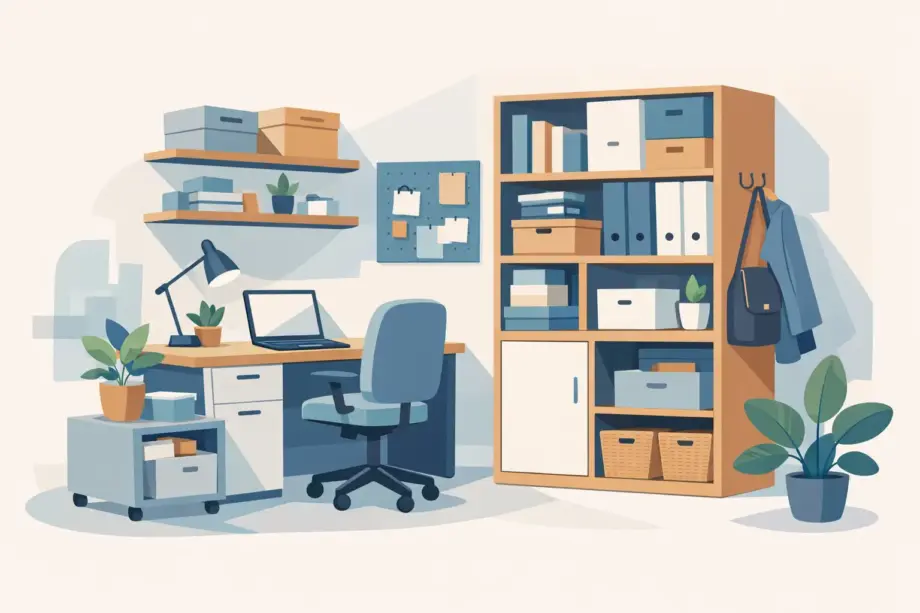
Under-desk storage is another strong option when selected carefully. Mobile pedestals and compact drawer units keep essentials close without demanding another footprint. They are especially useful in private offices, hot desk settings, and admin spaces where the desk itself has to perform multiple roles.
There is also a visual trade-off to consider. Too many separate small units can make a room feel busier than one well-scaled storage wall. In client-facing offices, fewer pieces with cleaner lines often create a more professional result.
Vertical storage can free the floor
When square metreage is tight, vertical storage usually delivers the biggest gain. Shelving, lockers, and tall cabinets shift capacity upward and preserve valuable floor space for movement and seating.
Open shelving suits spaces where quick access matters and visual order can be maintained. It works well for books, labelled binders, and display material in design studios, consult rooms, and home offices. Closed cabinets are the better choice where paperwork, consumables, or personal items need to stay out of sight. They also create a tidier impression in reception-adjacent spaces and executive rooms.
A balanced mix often performs best. Open shelves on top can keep reference materials accessible, while closed lower storage hides the operational mess. This combination feels lighter than a full bank of solid cabinetry but still supports day-to-day function.
Corners and dead zones deserve attention
Corners are often wasted because standard furniture dimensions do not quite fit. In a small office, that lost area adds up quickly. Corner bookcases, compact cupboards, and L-shaped desk arrangements with integrated storage can turn an awkward pocket into useful capacity.
Likewise, transitional spaces such as printer stations, hallway niches, or the gap between a desk and a wall can become storage assets. Slimline shelving, credenzas, and low cabinets are effective here, provided they do not interfere with door swings or compliance clearances.
Choose storage by work type, not just by size
Two offices with the same footprint can need very different storage. A finance team, a sales office, and a home-based consultancy will not store the same things, and forcing one generic solution onto all three tends to create clutter elsewhere.
Paper-heavy workplaces still benefit from drawers, filing cabinets, and lockable cupboards sized around active records. Businesses moving toward digital systems may need less filing but more concealed storage for devices, chargers, accessories, and meeting equipment. Shared offices often need personal storage too, especially where staff rotate desks or split time between home and office.
Security matters as well. Lockable storage is not only for sensitive files. It is useful for petty cash, keys, client material, technology, and staff belongings in open-plan environments. In small spaces, these functions are often combined, so choosing units that can support both storage and security is practical rather than excessive.
Make furniture do more than one job
The most effective office storage for small spaces often comes from multi-purpose furniture. A credenza can store documents while also serving as a printer station. A storage bench can provide seating in a waiting area. A desk with integrated drawers reduces the need for extra units. Modular workstations with overhead or under-desk components can create a more resolved layout than mixing separate pieces over time.
This is especially valuable in commercial fit-outs where every item needs to justify cost, footprint, and appearance. Multi-use furniture can reduce the total number of products required, simplify procurement, and create a cleaner visual outcome.
There is a limit, though. Overloading one piece with too many functions can create congestion. For example, a cabinet that stores archived files, houses the printer, and acts as a bag drop may become a bottleneck in a busy team area. The right choice depends on how many people share the zone and how often they access it.
Storage should match the look of the office
In compact rooms, furniture is more visible. That means storage cannot be treated as an afterthought. Finishes, proportions, and material choices all influence whether a small office feels polished or pieced together.
Lighter finishes can help a room feel more open, while darker tones can add presence and contrast when balanced with good lighting. Timber-look surfaces bring warmth to home offices and client-facing spaces. White and neutral palettes suit modern commercial interiors and can make dense storage feel less heavy. Powder-coated steel and commercial laminates are practical options where durability and easy cleaning matter.
Consistency also helps. Matching desks, storage units, and meeting furniture creates cohesion, which is particularly important in small spaces where visual noise builds quickly. This is one reason buyers often prefer to source from a supplier with broad category coverage rather than patching together pieces from multiple ranges.
Durability, access and delivery all matter
Small-space storage is not just a design decision. It is an operational one. Units need to withstand regular use, open and close properly in tight layouts, and arrive on time for fit-outs, office moves, or business upgrades.
Commercial-grade construction is worth prioritising, especially in shared offices, reception zones, education settings, and workplaces with high daily traffic. Drawer runners, hinges, locking systems, and surface finishes all affect long-term performance. A cheap cabinet that warps, chips, or jams under load is rarely a saving.
It is also worth checking dimensions carefully against access points. In smaller premises, stairwells, lifts, and narrow doorways can affect what is practical to deliver and install. Flat-pack convenience may suit some buyers, while fully assembled pieces can save time in others. The right answer depends on site conditions, labour availability, and how quickly the space needs to be operational.
For buyers furnishing on a deadline, ready-to-ship stock and dependable dispatch are often as important as style. That is where a supplier like Furniture Pro Australia can add real value – not simply by offering storage options, but by helping buyers source coordinated, commercial-grade pieces with greater confidence around lead times and service.
A smarter way to plan small office storage
If the space is tight, resist the urge to solve clutter by adding furniture piece by piece. That usually fills the room without fixing the system. Instead, plan storage as part of the full workspace: desk size, staff movement, visitor sightlines, technology placement, and the items that need to be hidden, secured, or reached quickly.
Small offices perform best when storage feels built into the room’s logic rather than squeezed in afterwards. When that happens, the office looks calmer, works harder, and leaves a better impression on both staff and clients.
The smartest storage choice is not always the biggest unit or the cheapest one. It is the one that makes a limited footprint easier to use every single day.