



Office Desks That Work Harder for Your Business
A desk is rarely just a desk in a working business. It is where staff handle client calls, manage orders, review plans, process invoices and keep daily operations moving. The right office desks make those tasks feel organised and professional; the wrong ones create clutter, restrict movement and make an otherwise polished fit-out look unfinished.
For office managers, business owners and fit-out professionals, the best choice comes down to more than a preferred finish. Desk dimensions, cable management, storage, durability and delivery timing all affect whether a workstation genuinely suits the space. Here is how to specify desks that work for the people using them and the business behind them.
Start with how the workspace actually operates
Before comparing colours or configurations, look at the work being done at each station. A reception employee may need a generous surface for a monitor, phone, visitor paperwork and secure storage. An accounts team may need room for dual screens and document trays. A project team may benefit from bench-style workstations that keep colleagues connected while making efficient use of floor space.
This is also the point to decide whether every team member needs the same set-up. Uniform desks create a clean, coordinated look and simplify procurement, particularly across multiple locations. However, a one-size-fits-all layout can be inefficient when roles vary significantly. A manager handling confidential files, for example, may need a pedestal drawer unit, while a hot-desking area may be better served by shared lockers and clear desktops.
Measure circulation as carefully as desk footprints. A workstation that fits on a floorplan can still feel cramped if chairs cannot be pushed back comfortably or colleagues cannot pass behind one another. Allow for access to drawers, power points, windows and meeting rooms. In compact offices, a smaller desk with integrated storage often performs better than a large executive-style desk that consumes valuable walkway space.
Choose office desks by layout, not trend
A strong office layout supports concentration, collaboration and easy supervision without making the room feel crowded. The most suitable desk format depends on the room and the rhythm of the team.
Straight desks for flexible placement
Straight desks are a practical choice for private offices, reception back-of-house areas and rows of individual workstations. Their simple shape makes them easy to position against a wall, divide with screens or rearrange when teams change. They are also a sensible option for businesses that need to furnish quickly from available stock without committing to a highly customised layout.
A straight desk needs enough depth for the technology on it. Shallow desktops may work for laptop-based roles, but they can quickly become restrictive with a monitor, keyboard, phone and paperwork. For screen-heavy work, prioritise a deeper work surface and a layout that allows the monitor to sit at a comfortable viewing distance.
Corner desks for focused work zones
L-shaped or corner desks make productive use of corners and provide separate zones for computer work and paperwork. They suit managers, administrators, designers and anyone who regularly switches between digital tasks and physical documents. The extra surface area is useful, but only when it does not overwhelm the office or restrict access around the desk.
Pay attention to left- and right-hand returns before ordering. It is a small specification detail that has a major effect on placement, especially where doors, filing cabinets or windows dictate the room layout.
Workstations for shared office floors
Bench desks and multi-person workstations help create orderly, space-efficient teams areas. They are ideal for growing businesses, call centres, co-working spaces and operational offices where consistent desk positions make sense. Shared frames can also reduce visual clutter compared with a collection of unrelated individual desks.
The trade-off is privacy. Open workstations encourage communication but can increase noise and visual distraction. Add desk screens where focused work, confidential conversations or acoustic separation are priorities. Screen height matters: lower screens preserve sightlines and a connected atmosphere, while higher options provide greater division.
Height-adjustable desks for movement
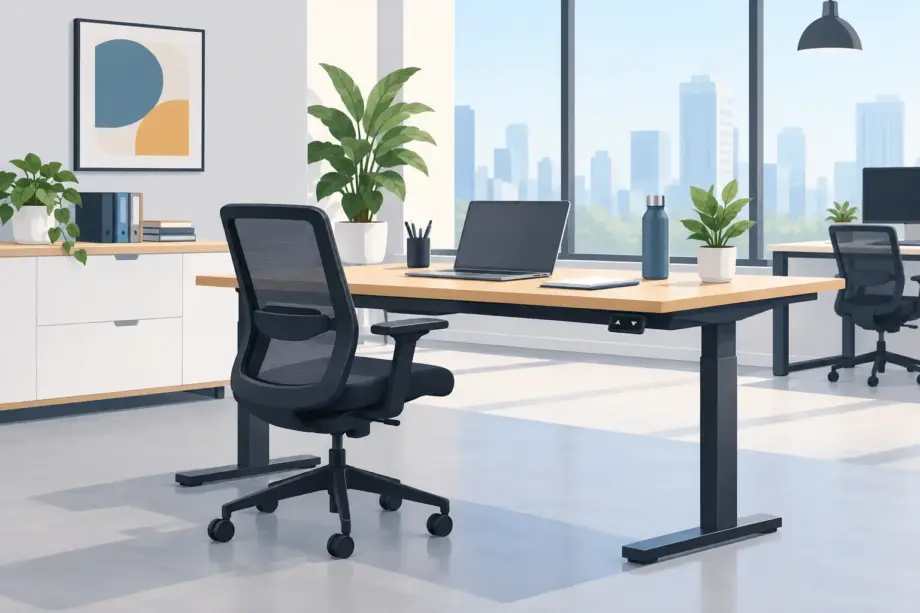
Height-adjustable desks give staff the option to alternate between sitting and standing during the day. They can be a worthwhile investment for roles involving long periods at a screen, particularly when paired with an ergonomic chair and correctly positioned monitor. They are not essential at every workstation, though. In a high-turnover hot-desk area, a durable fixed-height desk may be simpler to manage and deliver better value.
When selecting sit-stand options, consider adjustment range, load capacity and the equipment staff will keep on the desktop. A desk should lift smoothly with monitors and accessories in place, rather than becoming unstable once the workday begins.
Prioritise commercial materials and construction
A desk in a busy workplace faces more wear than a domestic piece of furniture. Bags are placed under it, chairs knock against legs, cleaners work around it and cables are moved during technology upgrades. Commercial-grade office furniture should be selected with those everyday demands in mind.
Melamine tops are popular for their clean appearance, easy-care surface and broad range of finishes. They suit most administration, education and professional office environments. Timber-look finishes can introduce warmth to a client-facing space, while white and light neutral tops help smaller rooms feel open. Darker finishes can look refined but may show dust, fingerprints or scratches more readily in high-use settings.
Frames deserve equal attention. A stable steel base helps prevent wobble, particularly on longer workstations or desks supporting multiple screens. Adjustable feet are useful where flooring is uneven, while a modesty panel can create a neater presentation in reception areas and offices where visitors sit opposite staff.
Check the practical details before purchase: edge finishing, drawer runner quality, load ratings, frame finish and warranty coverage. These details are not decorative extras. They determine how well a desk holds up once the office is fully operational.
Plan power, cables and storage from day one
An attractive office can look untidy within a week if cords, chargers and power boards have nowhere to go. Build cable management into the desk specification rather than treating it as an afterthought. Cable ports, under-desk trays and shared power access keep work surfaces clear and make cleaning easier.
Where desks are positioned in the middle of a room, confirm how power will reach them before finalising the layout. Floor boxes may be available in one tenancy and not another. In some cases, positioning workstation banks closer to perimeter power points is the most cost-effective solution.
Storage should match the work process. Mobile pedestals keep everyday files and stationery close at hand, while credenzas and storage units suit shared supplies, printers and archived material. For hybrid teams, personal lockers can be more valuable than individual drawer units because they support staff who do not use the same desk every day.
Create a consistent look across customer-facing spaces
In professional services, sales offices and hospitality administration areas, the office is part of the brand experience. Clients notice whether the reception counter, meeting table, task seating and desks feel intentionally selected. Matching finishes and coordinated frames make even a practical workspace feel considered.
That does not mean every furniture item must be identical. A timber-look desk paired with black frames and charcoal seating can bring warmth and definition to a contemporary office. In a venue setting, the back office can use hard-wearing workstation furniture while public-facing administration or host stations carry a more refined finish that complements the dining or lounge area.
Furniture Pro Australia offers office desks, workstations, storage and ergonomic seating that can be selected as part of a coordinated commercial furniture package. Choosing related pieces at the same time helps avoid mismatched finishes and reduces the time spent sourcing individual items from different suppliers.
Buy for the next stage, not just opening day
A desk purchase should account for likely changes over the next few years. A business expecting to add staff may benefit from modular workstation systems that can be extended rather than replaced. A tenant on a short lease may prefer adaptable desks that can be reconfigured easily at the next premises.
Stock availability and dispatch time are equally relevant when an office opening, relocation or refurbishment has a fixed deadline. Confirm quantities early, particularly when fitting out a larger floor or matching furniture across several sites. Delivery access also matters: check lift dimensions, loading dock arrangements, stairs and whether assembly is required before the furniture arrives.
The strongest office fit-outs are not built around the biggest desk or the lowest unit price. They are built around work that flows, spaces that present well and furniture that continues to perform after the excitement of opening day has passed.