



Best Restaurant Table Materials Explained
A table that looks sharp on opening night can become a maintenance problem by month three. In a busy venue, restaurant tables deal with hot plates, spills, cleaning chemicals, chair knocks and constant traffic. That is why choosing the best restaurant table materials is less about trend and more about matching finish, durability and upkeep to the way your venue actually runs.
For restaurant owners, venue managers and fit-out teams, the right material affects more than appearance. It changes cleaning time, replacement cycles, customer perception and long-term cost. A beautiful top that stains easily or chips at the edges can turn into an expensive choice very quickly.
How to judge the best restaurant table materials
The strongest choice depends on service style, location and turnover. A quick-service café needs something different from a premium dining room, and an outdoor coastal venue has a different set of pressures again.
Start with four practical questions. How hard will the tables be used each day? How much maintenance can your team realistically manage? What kind of look are you trying to create? And how often do you want to replace or refinish tops? Those answers usually narrow the field faster than any trend forecast.
Commercial buyers also need to think about consistency across multiple tables. A material might look excellent in one hero setting, but if you are furnishing twenty or fifty tables, stock availability, finish matching and ease of replacement matter just as much as style.
Best restaurant table materials for indoor venues
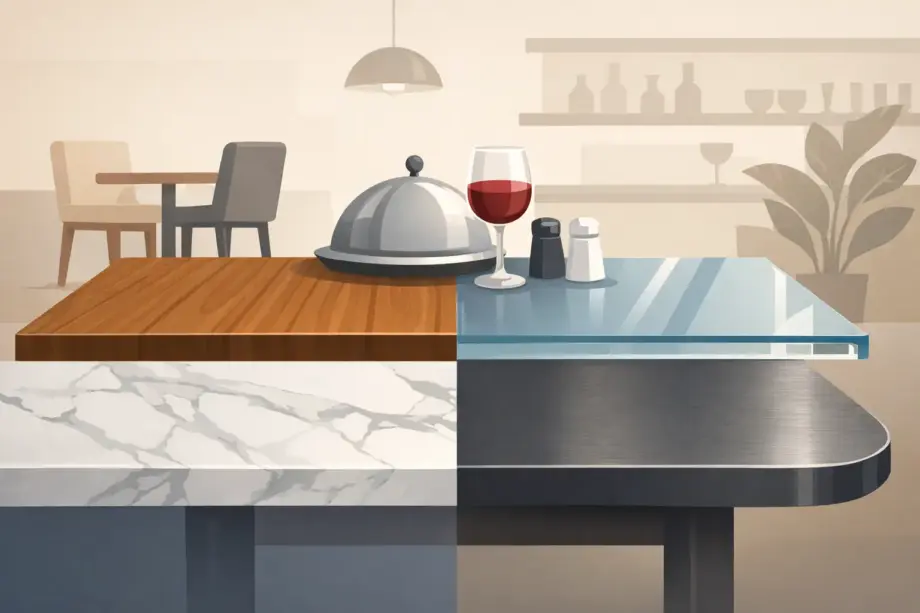
Solid timber
Solid timber remains one of the most popular choices because it brings warmth, texture and a more premium feel. In restaurants where atmosphere matters, timber helps soften the room and makes the space feel established rather than purely functional.
The trade-off is maintenance. Timber can mark, stain or move with changes in temperature and humidity if it is not properly finished. In busy hospitality settings, that means you need a commercial-grade seal and a realistic plan for ongoing care. Some operators are happy with the character that comes from wear. Others want a cleaner, more uniform presentation and may find solid timber too demanding.
Timber works particularly well in full-service dining, wine bars and venues aiming for a natural or contemporary aesthetic. It is less ideal where turnover is very high and tables are cleaned aggressively all day.
Laminate
Laminate is often the most practical answer for operators balancing budget, durability and visual consistency. It has come a long way in appearance, with finishes that can mimic timber, stone and other textures without the same maintenance burden.
For many venues, laminate earns its place because it is easy to clean, resists everyday staining and offers strong value across larger fit-outs. It suits cafés, family restaurants, food courts and casual dining spaces where functionality has to come first.
Its limitation is perception. In higher-end settings, some laminate finishes can look flatter or less authentic than natural materials. That does not make laminate a poor choice. It just means the finish selection needs care, especially when tables play a big role in the overall design brief.
Veneer
Veneer sits between solid timber and laminate. It gives you the look of real timber with a more controlled and often more cost-effective construction. For operators wanting a refined finish without the full price and movement of solid timber, veneer can be a smart middle ground.
The catch is that veneer is not as forgiving as laminate when it comes to impact damage or harsh treatment. Once the surface is deeply scratched or chipped, repair can be more involved. In venues where guests and staff are hard on furniture, veneer can age faster than expected.
Still, for restaurants with a design-led interior and moderate wear, veneer can deliver a polished result without overreaching the budget.
Compact laminate
If standard laminate is the practical all-rounder, compact laminate is the tougher commercial option. Made as a dense, self-supporting panel, it performs well in high-use environments and is especially useful where moisture resistance matters.
Compact laminate suits indoor and semi-outdoor hospitality spaces, and it is a strong candidate for cafés, clubs and venues that need hard-working surfaces without constant upkeep. It is also useful when you want a slim modern profile with strong structural performance.
The look is usually more contemporary than traditional. If your venue leans heavily into natural textures or fine dining cues, another finish may feel more aligned.
Stone and sintered surfaces
Stone tops, including engineered stone alternatives and sintered surfaces, bring a high-end visual impact that few other materials can match. They project permanence, quality and a more premium dining experience.
They also come with practical considerations. Weight is a major one, especially for venues that move tables often or need flexible floor layouts. Cost is another. And while many stone-like surfaces are highly durable, edge chipping and transport handling need attention in commercial settings.
These materials are best suited to restaurants where tables are part of the design statement and where the operating model supports a higher upfront investment. They are less suited to fast-paced venues that reconfigure tables regularly or prioritise lightweight furniture.
Best restaurant table materials for outdoor use
Aluminium and metal tops
Metal table tops, particularly aluminium, are a dependable option for outdoor dining areas. They handle weather well, are generally easy to maintain and work with a broad range of hospitality styles, from modern rooftops to casual beer gardens.
For coastal venues, corrosion resistance is the key issue. Not all metals perform the same way, and the finish matters. Powdercoated aluminium is often a sensible choice, but exposure level and maintenance still need consideration.
Metal can feel cooler and more utilitarian than timber or stone-look finishes, so it is usually strongest in casual or contemporary settings rather than intimate dining rooms.
Compact laminate outdoors
Compact laminate deserves a second mention because it performs particularly well outside. It resists moisture better than many traditional table materials and is a strong fit for cafés, restaurants and clubs with exposed dining zones.
It also gives operators flexibility on style. You can achieve a clean, modern look or a timber-inspired finish without taking on the same maintenance burden as natural wood outdoors. For many Australian venues dealing with sun, rain and fast table turns, this is one of the safest commercial choices.
Treated timber
Outdoor timber has obvious visual appeal. It softens hard surfaces and suits garden dining, pubs and coastal hospitality spaces beautifully. But in Australian conditions, timber outdoors needs commitment. Sun exposure, moisture and temperature shifts can all accelerate wear.
If you choose treated timber, do it with a clear maintenance plan. Without regular care, the finish can fade, crack or become uneven. Some operators accept that weathered look. Others do not. The right answer depends on whether your brand can absorb a bit of natural ageing or needs a cleaner, more controlled presentation.
Matching material to service style
The best restaurant table materials are rarely chosen in isolation. They need to suit the pace and personality of the venue.
A fast-casual venue with heavy daily turnover usually benefits from laminate or compact laminate because cleaning speed, impact resistance and replacement cost matter more than material prestige. A premium restaurant may justify timber, veneer or stone-like surfaces because the table is part of the guest experience and average spend is higher.
For outdoor-heavy venues, weather performance often overrides everything else. A material that looks exceptional indoors may become a poor investment if it cannot handle rain, UV exposure or salt air. This is where a commercially minded buying decision pays off. The best-looking option is not always the best-performing one.
Procurement realities buyers should not ignore
Material choice is only one part of the purchase. Commercial buyers also need to consider lead times, stock depth, consistency across batches and whether replacement tops will still be available later.
That matters during staged fit-outs, refurbishments and venue expansions. If a supplier cannot support matching stock or practical after-sales service, a good material choice can still become a frustrating procurement outcome. This is why many operators prioritise commercial-grade ranges that are built for repeatability and service support, not just showroom appeal.
There is also the issue of base compatibility. Heavy tops need the right support. Larger table formats need stability. The wrong pairing can shorten product life regardless of how durable the top material is.
So what is the best choice?
If you want the broadest commercial reliability, laminate and compact laminate are hard to beat. They cover most hospitality settings, keep maintenance manageable and make sense for venues focused on efficiency and value.
If your brief is more design-led, solid timber and veneer offer warmth and presence, provided you are comfortable with a bit more care. If you are building a premium interior and want the tables to carry visual weight, stone-inspired surfaces can make sense, but only if layout flexibility and budget are not the top priorities.
For outdoor areas, compact laminate and suitable metal finishes usually deliver the strongest balance of durability and practicality in Australian conditions.
A well-chosen table material should do its job quietly. It should suit your brand, stand up to service and still look right when the room is full on a Saturday night. If you are selecting for real operating conditions rather than just a sample board, you are already on the right track.