



Banquette Seating vs Loose Chairs for Venues
A packed Friday service quickly exposes whether a floor plan is working. Guests need a comfortable place to settle in, staff need clear paths to deliver meals, and every seat needs to earn its footprint. The choice between banquette seating vs loose chairs affects all three – along with cleaning routines, fit-out cost, capacity and the look customers remember.
For hospitality venues, there is no universal winner. Banquettes can turn an awkward wall or corner into high-value seating, while loose chairs make it far easier to reset the room for changing group sizes and events. The right answer comes from how the space operates at its busiest, not simply which option looks better on a mood board.
Banquette seating vs loose chairs: the commercial difference
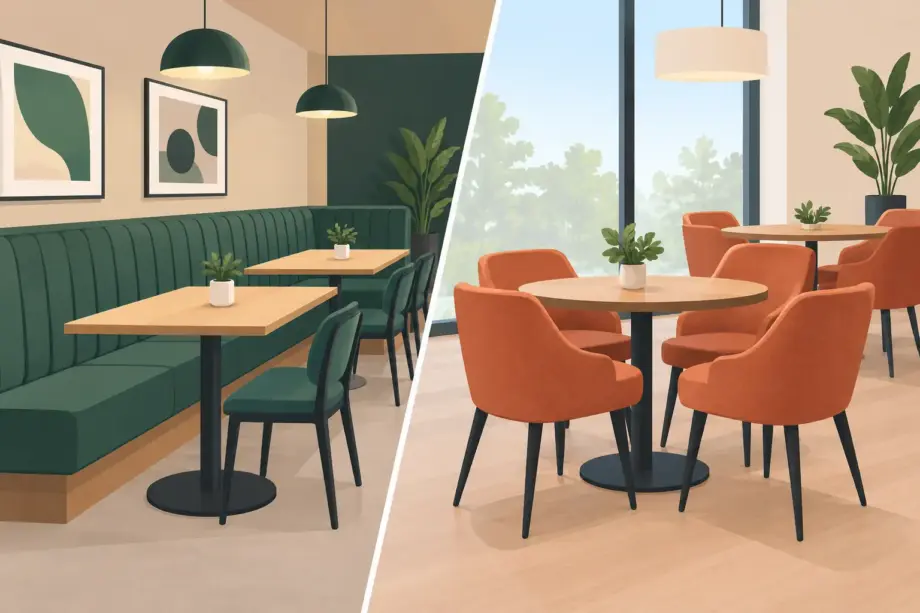
Banquette seating is fixed or semi-fixed upholstered bench seating, usually positioned against a wall, in a booth, around a corner or along a window line. It creates a built-in appearance and can be designed around the exact dimensions of a venue. In cafés and restaurants, it is often paired with pedestal tables and loose chairs on the opposite side.
Loose chairs are individual, movable seats. They may be timber, metal, polypropylene, upholstered or a mix of materials, and they can be used with standard dining tables, communal tables or bar-height settings. Their strength is adaptability: a team can move them, replace them or add more seating without altering the fit-out.
Both options can be commercial-grade and visually refined. The decision is really about fixed capacity versus flexible capacity.
When banquette seating makes better business sense
Banquettes are particularly effective where space is tight or shaped awkwardly. A continuous bench along a wall removes the gaps that individual chair backs and pull-out zones create. In a narrow café, that can make circulation feel more deliberate while still providing generous seating.
They also help establish a venue’s personality. A high-backed upholstered banquette can add acoustic softness and a sense of privacy in a busy restaurant. A low-profile vinyl bench can create a cleaner, more casual diner or club look. In office breakout areas, banquettes can define a meeting nook without the formality of a boardroom.
Capacity is another major advantage. A well-planned banquette can accommodate groups of varied sizes, especially when paired with tables that can be joined together. Guests are often comfortable sliding along a bench to make room for another person, whereas loose chairs require a dedicated position for every diner.
Banquettes can also improve cleaning around the perimeter of the room. There are fewer chair legs to move around when vacuuming or mopping, and the space beneath a fully plinthed bench is enclosed rather than collecting dust, crumbs and stray napkins. For venues with frequent turnover, this can simplify end-of-day cleaning.
The trade-offs with fixed seating
The same permanence that makes a banquette efficient can reduce flexibility. Once it is installed, changing table spacing, increasing aisle width or reworking a section for private functions is more involved than simply shifting chairs.
Access needs careful attention too. A deep booth may be comfortable for a long lunch, but guests seated against the wall need others to stand before they can leave. That is less convenient for quick-service dining and may not suit all customers. Consider accessible seating positions at tables with loose chairs, especially where a wheelchair user or guest with limited mobility needs a straightforward approach.
Upholstery selection matters. Fabric can bring warmth and texture, but it may be less practical in a high-spill environment. Hospitality vinyl, commercial-grade leather-look finishes and wipeable upholstery are usually better suited to cafés, restaurants, pubs and family venues. Specify durable foam, strong internal construction and easy-clean surfaces from the start, rather than treating the banquette as decorative joinery.
Why loose chairs remain the flexible option
Loose chairs give operators control over the room long after opening day. A two-person table can become a four-person table, a dining area can be cleared for an event, and extra chairs can be brought out when bookings run ahead of forecast. For venues hosting private functions, changing weekday trade patterns or seasonal demand, that flexibility has real value.
They also make replacement easier. If one chair is damaged, worn or no longer suits the look of the venue, it can be swapped without disrupting an entire seating run. This is useful for high-traffic hospitality settings, clubs and shared office spaces where furniture works hard every day.
From a procurement perspective, loose seating can be faster to stage. Commercial chairs held in Australian stock can be ordered in quantities that match the immediate fit-out, then topped up later where the same range remains available. That can be preferable for a new venue managing cash flow, or for an office expanding in stages.
Loose chairs create a more open visual rhythm as well. They allow daylight through a room, make tables feel less enclosed and suit layouts where customers are not expected to sit for extended periods. A contemporary café with a fast breakfast trade may benefit more from light, stackable chairs than deep booth seating.
The operational limits of loose chairs
Loose chairs need space to work properly. Staff and customers need room to pull them out, sit down and pass behind occupied tables. If the floor plan is too tight, chairs can quickly migrate into walkways and create bottlenecks during service.
They also create more daily handling. Chairs are pushed, dragged, knocked and moved repeatedly. Choosing a commercial chair with durable feet, a stable frame and an appropriate weight is essential. A chair that is too light may feel unstable; one that is too heavy can slow cleaning and make rapid resets harder for staff.
For outdoor dining, loose chairs are often the practical choice because they can be moved inside, stacked or secured as conditions change. However, materials must suit the exposure. UV-stable polypropylene, powder-coated aluminium and weather-resistant finishes generally offer better long-term value than residential furniture that looks good briefly but deteriorates under commercial use.
Plan the floor before choosing the furniture
The best seating choice starts with a measured plan, not a product shortlist. Mark walls, door swings, service stations, power points, window lines and emergency access first. Then test the route a staff member takes while carrying a tray, not just the route a seated guest takes.
For banquettes, consider seat height, seat depth, back height and table base position together. A table set too far from the bench is uncomfortable, while a poorly located pedestal base can make entering the seat awkward. Booth tables should allow diners to sit without feeling compressed, especially if plates, laptops or shared dishes are part of the usual service.
For loose chairs, allow for the chair to be pulled back and for traffic to pass behind it. It is tempting to maximise table count on paper, but an overcrowded room creates poor service, damaged furniture and an uncomfortable customer experience. A slightly lower capacity with better movement can deliver stronger turnover and better reviews.
Acoustics deserve consideration. Upholstered banquettes can absorb some sound in hard-surfaced venues, whereas timber, metal and polypropylene chairs reflect it. This does not mean every restaurant needs soft seating, but in a lively room with tiled floors and exposed ceilings, a mix of upholstered seating, curtains, acoustic treatment or softer finishes can make conversation easier.
A hybrid layout is often the strongest solution
Many successful venues use both. Banquette seating along walls, bays or windows gives the room a tailored and efficient foundation. Loose chairs on the open side of tables preserve flexibility, while a central zone of movable tables and chairs can adapt to bookings, larger groups and functions.
This approach also helps create seating variety. Guests on a quick coffee run may choose a simple chair near the front, while couples and groups booking dinner may prefer the comfort and privacy of a booth. In offices, a banquette nook can support informal catch-ups while loose chairs serve training rooms, meeting spaces and hot-desking zones.
A hybrid approach is particularly useful when refreshing an existing venue. Rather than committing the entire budget to custom fixed seating, invest in one high-impact banquette area and support it with durable loose chairs that can be reordered as the business grows. Furniture Pro Australia’s commercial range can help buyers coordinate chairs, tables and supporting pieces without losing the flexibility needed in a working venue.
Questions to ask before ordering
Decide how often the layout must change, how long customers typically stay, and whether staff can comfortably move through the busiest section of the room. Consider the cleaning regime, likely spills, accessibility requirements and whether replacement seating may be needed at short notice. Finally, assess whether the furniture supports the atmosphere you are selling: fast and casual, quiet and intimate, polished and corporate, or relaxed and social.
Choose banquettes when you need a tailored footprint, strong visual identity and efficient perimeter seating. Choose loose chairs when adaptability, easy replacement and event-ready layouts matter most. The most effective commercial spaces are not furnished around a single trend – they are planned around the people who will use them every day.