



10 Best Reception Desks for Offices
The front desk does more than greet visitors. It sets the pace for every arrival, supports daily admin, and quietly signals whether a business is organised, current and ready for work. When buyers start comparing the best reception desks for offices, the right choice usually comes down to three things – how the space functions, how the brand needs to present, and how quickly the desk can handle real day-to-day traffic.
A reception desk has to work harder than it looks. It needs to give staff enough room to check in guests, answer calls, manage deliveries and keep paperwork controlled, while still presenting a clean face to clients, patients, contractors or candidates walking through the door. That balance is where many office fit-outs either look sharp and feel awkward, or perform well and look underdone. The better desks do both.
What makes the best reception desks for offices?
There is no single desk that suits every workplace. A compact accounting office, a medical practice, a corporate tenancy and a co-working lobby all ask different things from their reception point. The best reception desks for offices are the ones that match traffic flow, staff tasks and brand presentation without wasting floor space.
Size is the first filter. In a smaller foyer, an oversized desk can choke circulation and make the entrance feel defensive. In a larger commercial lobby, a small desk can look temporary and leave reception staff exposed. The right proportion should allow visitors to approach comfortably, staff to move easily, and adjacent waiting furniture to sit naturally in the room.
The second filter is workflow. If reception is mostly greeting visitors and directing calls, a simple straight desk with modest storage may be enough. If staff are processing parcels, handling files, printing documents and managing appointments all day, built-in returns, lockable storage and a generous work surface matter far more than a decorative finish.
Then there is appearance. Reception furniture is one of the few office pieces that every visitor sees. Clean lines, considered materials and a tidy front panel help present a business as credible and established. That does not always mean expensive. It means choosing a desk that looks deliberate rather than improvised.
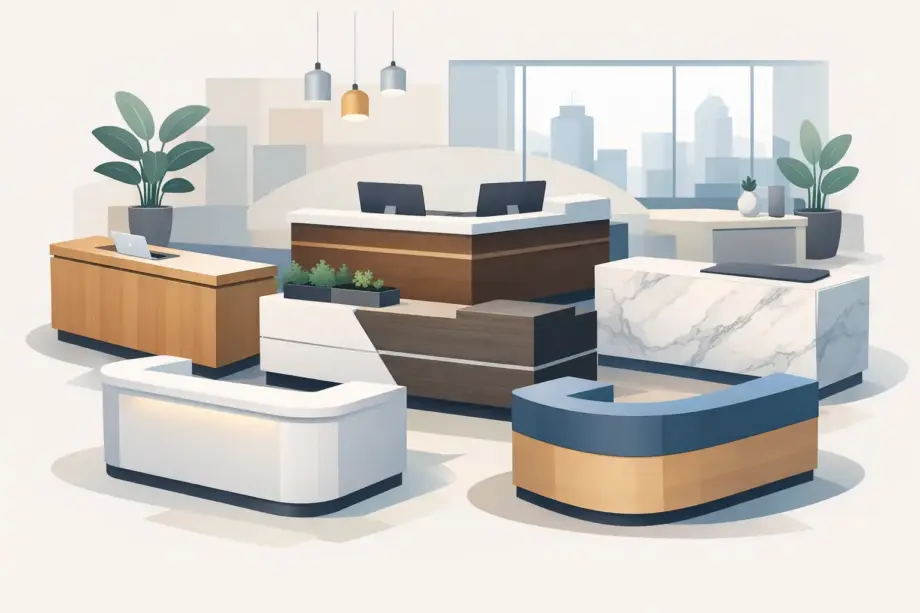
10 best reception desk styles for office use
1. Straight reception desks
A straight desk is often the most efficient option for small to mid-sized offices. It is easy to place, easy to pair with waiting chairs, and usually the most cost-effective path when budget and lead time matter. For businesses fitting out a practical front-of-house area quickly, this style often gives the best return.
The trade-off is presence. In a larger foyer, a basic straight desk can feel light on impact unless the finish, front panelling or backdrop does some of the visual work.
2. L-shaped reception desks
L-shaped desks suit teams that need separate zones for greeting and admin. One side can handle visitors while the return supports computer work, paperwork or device charging out of direct sight. They also help define the reception footprint without requiring a fully enclosed counter.
They do need more planning. Corners, walkways and door clearances matter, so measuring the room properly is essential.
3. U-shaped reception desks
For busy reception points, U-shaped desks create a stronger workstation with more enclosed working area. They are common in clinics, larger offices and sites where multiple staff need to operate from reception at the same time.
This style delivers function, but it can feel too substantial in a compact entry. It works best where reception is a genuine operations hub, not just a meet-and-greet point.
4. Curved reception desks
Curved designs soften the entrance and make the approach feel more welcoming. They suit design-led offices, creative studios and customer-facing businesses that want a polished first impression without a severe corporate look.
The trade-off is usually price and placement flexibility. Curved desks can cost more and may be less forgiving if the room layout changes later.
5. Modular reception desks
Modular systems are useful when fit-outs need adaptability. They can be configured to suit changing teams, staged refurbishments or multi-site rollouts where consistency matters. For procurement teams, modularity can make future expansion simpler.
Not every modular option has the same visual finish as a fully integrated statement desk, so it pays to balance flexibility with presentation.
6. Reception desks with high transaction counters
A raised transaction counter creates a cleaner visitor-facing surface and helps conceal monitors, cables and paperwork. It is particularly useful where staff need a bit more privacy or where reception handles regular public interaction.
The key is accessibility. If the counter is too high or there is no lower section available, the desk may not serve all visitors comfortably.
7. Open-concept reception desks
These desks feel lighter and more approachable. They work well in modern offices where the brand leans collaborative rather than formal, and where reception is intended to feel integrated with the broader space.
Open designs do expose more of the work zone, so they suit tidy, low-clutter workflows better than paper-heavy environments.
8. Timber-look reception desks
Timber-look finishes bring warmth without the cost or upkeep of solid timber. They are a strong fit for professional services, wellness spaces and offices wanting a more grounded, less clinical feel.
The finish matters here. A cheap-looking grain can drag down the whole entrance, while a well-chosen commercial laminate can look sharp and wear well.
9. White and minimalist reception desks
Minimalist white desks remain popular because they brighten a foyer and support a crisp, contemporary aesthetic. They pair easily with most office palettes and can help smaller entries feel larger.
They do show marks more readily, especially in high-traffic sites. In busy workplaces, durable surfaces and easy-clean finishes are worth prioritising.
10. Reception desks with integrated storage
For offices that need reception to stay orderly across long operating hours, integrated storage is often what separates a desk that looks good on day one from one that still performs six months later. Drawers, cupboards, cable management and room for printers or files make a substantial difference.
Storage-heavy desks can appear bulkier, so they need to be chosen carefully in tighter foyers. Still, for many businesses, hidden function is exactly what keeps the front-of-house area presentable.
How to choose the right reception desk for your office
Start with traffic, not style. Count how many people approach reception each day, how long they stay there, and what your staff actually do at the desk. A front counter for occasional visitors has very different requirements from one that manages couriers, bookings, payments or high call volumes.
Next, map the room. Measure the width, depth and ceiling height, then consider sightlines from the entry. The desk should be visible when someone walks in, but it should not dominate the room to the point that seating, displays or circulation suffer. A common mistake is buying for the catalogue image rather than the floorplan.
After that, think about finishes in commercial terms. Gloss surfaces can look smart but may show fingerprints. Dark colours can feel premium but may make a compact area feel smaller. Timber-look laminates can warm up a space while remaining easier to maintain than more delicate materials. There is no universal winner – the better choice depends on traffic level, cleaning routines and brand style.
Storage deserves more attention than many buyers give it. If staff need to lock away documents, store stationery, hide charging cables or keep spare consumables on hand, build that into the desk choice early. Adding loose storage later often creates visual clutter around the very area meant to look most controlled.
Lead time and stock availability also matter, especially for relocations and fit-outs working to handover dates. A well-specified desk is only useful if it can arrive when the office needs to open. For many Australian buyers, that makes local stock holding, dependable dispatch and metro delivery options part of the purchasing decision, not just an afterthought.
Materials, durability and day-to-day use
Reception desks in commercial settings need finishes that can handle constant contact. Laminate remains a strong option because it is durable, cost-effective and available in a wide range of colours and timber looks. Powder-coated metal details can add structure and a modern edge, while feature panels in textured finishes can lift the visual impact of the desk without complicating maintenance.
Glass can look refined, but it is not right for every office. It shows smudges quickly and may feel too formal or too exposed for practical reception work. Likewise, ultra-minimal detailing can photograph well and still be frustrating for staff if there is nowhere to place devices, paperwork or personal items.
That is the broader rule with reception furniture – commercial value sits in the combination of appearance, durability and function. If one of those three is missing, the desk usually underperforms.
The reception desk should fit the whole front-of-house plan
A good desk does not work alone. It needs to sit comfortably with visitor seating, side tables, storage, acoustic conditions and the general style of the fit-out. If the reception point is sleek and contemporary but the surrounding furniture feels mismatched, the entrance loses cohesion.
This is where category breadth can help buyers move faster. Being able to coordinate the desk with lounge seating, occasional tables, storage and office furniture from the same commercial range simplifies decision-making and reduces the risk of a front area that feels pieced together. For businesses furnishing on a schedule, that matters as much as the desk itself.
Furniture Pro Australia caters to that kind of practical procurement – commercial-grade options, ready-to-ship stock and fit-for-purpose designs that help workplaces look considered without slowing down the project.
The best reception desk is the one that keeps your front-of-house running smoothly while making the space feel established from the moment someone steps inside. If you choose with traffic, workflow and finish in mind, the desk stops being a standalone purchase and starts doing what it should – supporting the entire office from the front door onward.