



How to Choose Bar Stools for Any Space
A bar stool that looks right in a product image can feel completely wrong once it lands on site. Too low for the benchtop, too bulky for the layout, too delicate for daily trade – these are the mistakes that slow down fit-outs and create avoidable replacement costs. If you are working out how to choose bar stools, the best place to start is not style alone. It is the way the stool will be used, who will use it, and how hard it needs to work.
For hospitality venues, office breakout areas and commercial kitchens, bar stools need to do more than fill a gap under a counter. They need to support traffic flow, suit the height of the surface, hold up under repeated use and still contribute to the overall look of the space. That balance of function and finish is where a good buying decision is made.
How to choose bar stools by height
Height is the first filter because even the best-designed stool will fail if the proportions are off. As a rule, you want enough space between the seat and the underside of the counter for people to sit comfortably without feeling cramped. In most settings, that gap sits around 25 to 30 cm.
Kitchen counters and lower commercial benches usually suit counter stools, while higher bar tables and bar tops call for taller bar stools. If you are furnishing a venue, it is worth measuring every surface rather than relying on nominal bench heights. Joinery can vary, and a few centimetres either way can change how comfortable the stool feels over a full service.
Swivel and padded models can also sit differently in practice. A thick upholstered seat may slightly alter perceived height, while a footrail position can make a stool feel more or less comfortable depending on the user. On a quick sit-test, these details are easy to miss. Over long use, they matter.
Start with the setting, not the stool
A café window counter, a hotel bar, a staff lunchroom and a home island bench all ask different things of a stool. Before narrowing materials or finishes, define the use case clearly.
In hospitality, turnover and cleaning are constant considerations. Stools are moved, knocked, stacked against tables during cleaning and used by a wide mix of patrons. That usually pushes buyers towards commercial-grade frames, easy-clean surfaces and finishes that age well. In office environments, the priority may shift towards comfort, visual softness and consistency with workstations or breakout furniture. For covered outdoor areas, weather resistance becomes part of the decision from day one.
This is where buyers often save time by thinking in operational terms. Ask how often the stool will be used, whether customers will sit for ten minutes or two hours, and who will be moving it. A lightweight stool can be practical for flexible layouts, but in a busy venue it may also feel less stable than you want. A heavier stool can signal quality and stay put better, but it is less convenient for frequent resets. There is usually a trade-off.
Backless, low-back or full-back?
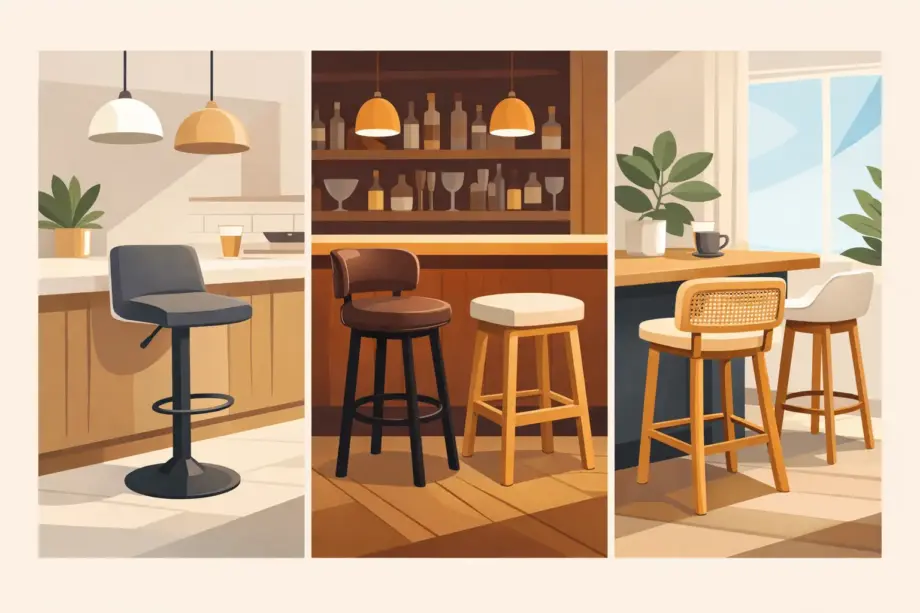
The shape of the stool affects both the look of the room and the way people use it. Backless stools are compact and clean-lined. They tuck neatly under benches, keep sightlines open and work well where space is tight. They are a strong option for quick-service venues, smaller kitchens and areas where stools are not occupied for long stretches.
Low-back and full-back bar stools offer more support and tend to encourage longer sitting. That can be an advantage in wine bars, restaurants, breakout spaces and residential settings where comfort matters more than a minimal footprint. The compromise is that they take up more visual and physical space, so spacing becomes more important.
Armrests can add another layer of comfort, but they are only practical when there is enough clearance between stools and beneath the bench. In many commercial layouts, arms make access harder and limit how tightly stools can be placed.
Material choice affects maintenance and lifespan
Materials do a lot of heavy lifting in commercial furniture. They shape the look, but they also determine maintenance demands, durability and suitability for indoor or outdoor use.
Timber bar stools bring warmth and texture, making them popular in cafés, restaurants and residential-style venues. They can soften harder interior finishes and help a space feel more inviting. The downside is that some timber finishes show wear faster than metal or polypropylene, particularly in high-turnover environments.
Metal stools are a practical choice for busy hospitality settings because they are durable, stable and often easier to maintain. Powdercoated finishes can support a wide range of interior palettes, from industrial to refined contemporary schemes. Even so, not all metal stools are equal. Weld quality, frame thickness and footrest construction all affect long-term performance.
Polypropylene and other easy-clean moulded materials are well suited to casual dining, staff areas and outdoor use. They are especially useful where spills are frequent and wipe-down speed matters. Upholstered stools lift comfort and appearance, but they need more care. In a restaurant or bar, fabric selection should be guided by cleanability as much as colour or texture.
Comfort is not just about cushioning
A padded seat may feel like the obvious choice, but comfort is broader than softness. Seat width, depth, footrest placement and back support all contribute to whether people can sit naturally.
If the stool will be used for meals, meetings or longer drinks service, support matters. A slim designer stool can look sharp, but if the seat is too narrow or the footrest is too high, guests notice quickly. In office breakout zones, comfort also influences whether the area is genuinely used or simply styled well and ignored.
For high-volume venues, it helps to think in terms of practical comfort. The stool should allow easy entry and exit, a stable seating position and enough support for the average user. Too much contouring can be as limiting as too little, especially when a broad range of customers will be using the furniture.
Spacing matters more than most buyers expect
One of the most common planning mistakes is choosing the right stool and the wrong quantity. Even when seat height is correct, overcrowding a counter makes the entire installation feel awkward.
As a general guide, each stool needs enough width for a person to sit, turn slightly and get in and out without bumping the next guest. Backless stools can sit closer together than full-back designs, but they still need breathing room. If your venue handles food service, extra spacing improves both comfort and staff access.
This is especially relevant in fit-outs where every seat counts. More stools do not always mean better capacity if the result is poor usability. In many cases, one less stool creates a better customer experience and a cleaner visual line.
Match the stool to the rest of the furniture
Bar stools rarely sit in isolation. They need to work with tables, dining chairs, joinery, flooring and lighting. A stool can be commercially sound and still feel wrong if it pulls against the rest of the scheme.
Start with the overall finish palette. If the space already includes warm timber tables and soft upholstery, an overly industrial stool may jar unless that contrast is deliberate. If the venue leans contemporary and pared back, a bulky traditional stool can add visual noise. Consistency does not mean every piece must match exactly, but there should be a clear relationship between materials, shape and tone.
For larger projects, this is where a broad commercial range becomes useful. Being able to coordinate stools with dining seating, tables or outdoor settings helps create continuity across zones without making the venue feel repetitive.
Think about procurement, not just design
A good stool on paper is only part of a good purchase. Stock availability, dispatch time, warranty support and replacement access all matter, especially for business buyers working to opening dates or staged upgrades.
If a stool is going into a commercial environment, check whether it is rated and built for that level of use. Ask practical questions. Is the frame suited to daily traffic? Is the finish easy to maintain? Can you reorder matching pieces later if the venue expands or a few units need replacing? These details can protect the look of a space long after the initial fit-out.
For many buyers, the smart choice is one that balances lead time, durability and visual impact. That is often where a supplier with commercial focus, local stock and after-sales support adds real value. Furniture Pro Australia speaks to that need because the buying decision is rarely just about one stool – it is about keeping a project moving with confidence.
How to choose bar stools without overcomplicating it
If you need a simple way to narrow the field, work in this order: measure the bench height, define the setting, choose the level of support, then shortlist materials based on cleaning and wear. After that, look at finish and style.
That sequence keeps the decision grounded in use rather than impulse. It also makes it easier to compare options that may look similar online but perform very differently once installed.
The right bar stool should feel considered, not risky. When height, comfort, durability and visual fit all line up, the result is a space that works better from the first service, first meeting or first morning coffee.