



What Size Meeting Table Fits Your Office?
A meeting table that looks right in a product image can feel completely wrong once chairs, laptops, power leads and people are in the room. When deciding what size meeting table to buy, the table itself is only one part of the calculation. The available room, number of regular users, chair footprint and circulation space all determine whether your meeting area feels professional and productive or cramped and inconvenient.
For offices, boardrooms, training spaces and shared work hubs, the best choice is usually the smallest table that comfortably supports the way your team actually meets. That leaves valuable floor space for movement, storage and future flexibility while still giving every attendee a usable work surface.
Start with the number of seats you need
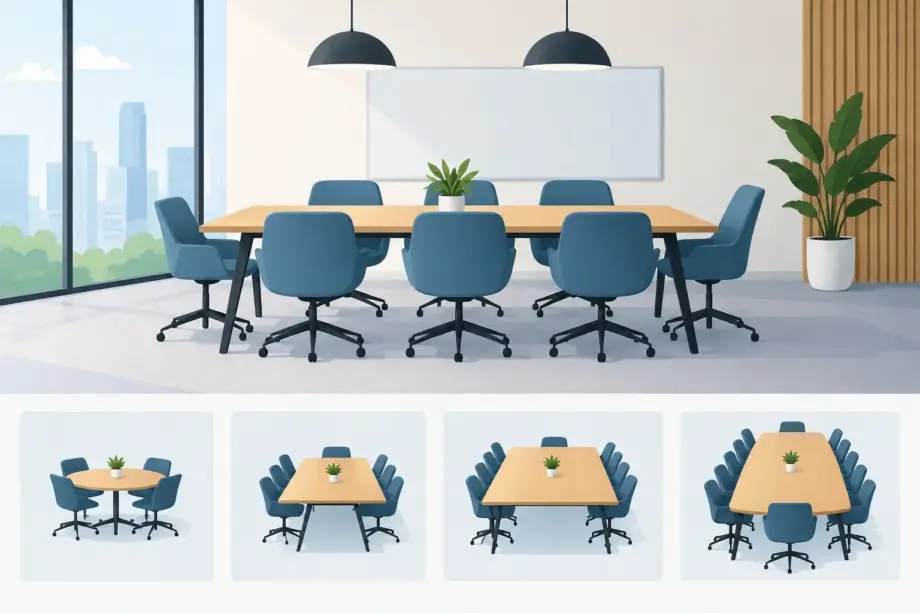
Seat count is the practical starting point. Consider the people who attend meetings every week, rather than planning around an occasional all-staff session. A six-person meeting table is often ideal for team catch-ups and client presentations, while an eight to ten-seat table suits a dedicated boardroom or management meeting space.
Allow around 600 mm of table edge per person as a working minimum. This gives each person room for a chair, notebook and laptop. For longer meetings, client-facing presentations or boardroom use, 700 to 750 mm per person is more comfortable. Wider personal space also helps when attendees need documents, water glasses or charging equipment on the table.
A quick guide can help narrow the options:
| Typical seating | Rectangular table size | Round table diameter | | — | — | — | | 4 people | 1200-1500 mm long x 750-900 mm wide | 1000-1200 mm | | 6 people | 1800 mm long x 900-1000 mm wide | 1200-1500 mm | | 8 people | 2400 mm long x 1000-1200 mm wide | 1500-1800 mm | | 10 people | 3000 mm long x 1200 mm wide | 1800-2100 mm | | 12 people | 3600 mm long x 1200-1400 mm wide | 2400 mm or larger |
These dimensions are a guide, not a fixed rule. A compact four-person room used mainly for quick stand-up discussions can work with a smaller table. A six-seat table used for formal presentations may need a larger top, particularly where people regularly bring laptops and printed plans.
What size meeting table works in your room?
Measure the complete room before choosing a table, including door swings, cabinetry, windows, wall-mounted screens and any built-in storage. It is easy to measure an empty floor area and overlook the space taken up by chairs once they are pulled back.
As a practical benchmark, allow at least 900 mm from the edge of the table to a wall or furniture. This gives users enough room to slide their chair back and move around the table. Where people will pass behind seated attendees, or where the room is a main access route, 1200 mm or more is a better allowance.
For example, a 2400 x 1200 mm eight-person table needs a room around 4200 x 3000 mm at a minimum when allowing 900 mm clearance on each side. A larger room will feel more generous and support easier movement, especially if the space has a credenza, display screen or catering trolley.
Do not assume a larger table always creates a more impressive boardroom. A table that fills nearly every square metre makes visitors feel boxed in and can make daily cleaning, maintenance and cable access harder. A well-proportioned table with good circulation usually presents better than an oversized boardroom setting.
Account for chairs, not just table dimensions
Commercial meeting chairs vary considerably in depth and width. A compact armless visitor chair may need less space than an ergonomic boardroom chair with arms, castors and a reclining mechanism. If you are selecting chairs and tables together, map out the full footprint before placing an order.
For chairs with arms, add extra space between seats so attendees are not knocking elbows. For mobile chairs, make sure castors have sufficient clear floor area and will roll safely on the selected flooring. In meeting rooms with carpet tiles, a suitable chair base and quality castors can make a noticeable difference to day-to-day use.
Choose a shape that matches the meeting style
Table shape affects more than appearance. It changes sightlines, seat capacity, accessibility and how the room functions during a typical workday.
Rectangular meeting tables
Rectangular tables are the most efficient choice for longer rooms and formal meetings. They provide clear positions at each end for a meeting leader or presentation screen, and they are easy to scale from four seats through to twelve or more. Modular rectangular tables can also offer useful flexibility in training rooms, where layouts may need to change from one session to the next.
The trade-off is that attendees at opposite ends of a long table can feel separated. For larger groups, consider integrated power access, video conferencing equipment and a table width that keeps screens visible without forcing people to lean forward.
Round meeting tables
Round tables suit collaborative discussions, interviews and smaller team meetings. Nobody sits at the head of the table, so conversation can feel more balanced. They also soften the layout of square rooms and reduce sharp corners in tight spaces.
A round table uses more floor area for the same number of people than a rectangular option. It is often an excellent choice for four to six seats, but can become difficult to navigate once the diameter exceeds 1800 mm. People at a very large round table may also struggle to reach shared documents or see a central display clearly.
Boat-shaped and oval tables
Boat-shaped or oval meeting tables create a refined boardroom look while improving movement around corners. Their tapered ends can make a medium-sized room feel less crowded than a full rectangular top. These styles work well for client meeting rooms where presentation matters, but they still require the same careful attention to seating space and clearance.
Plan for technology and everyday work
Modern meetings rarely involve just people and chairs. Laptops, monitors, HDMI leads, USB charging and video conferencing equipment need a place to go. Before finalising your table size, consider whether a central cable box, in-desk power module or nearby wall connection is required.
A table that is too narrow can leave screens and paperwork competing for space. For most laptop-based meetings, 900 to 1200 mm wide is a useful range. A 750 mm-wide table may suit short meetings or compact spaces, but it can feel restrictive for extended workshops, dual-screen setups or meetings involving samples and plans.
Also think about the room’s secondary uses. If the table will double as a hot-desk area, interview room or project workspace, prioritise generous depth and durable commercial finishes. If the room is primarily for quick check-ins, a smaller table paired with comfortable, stackable or mobile seating may deliver better value and flexibility.
Avoid the common sizing mistakes
The most common mistake is buying based on maximum capacity rather than normal use. A ten-seat table in a room normally used by four people consumes floor space without making everyday meetings better. Another is allowing enough space to push chairs back but not enough to walk behind them.
It is also worth checking delivery access early. Long boardroom tops may need to travel through lifts, corridors, doorways and stairwells before reaching the room. A modular table can be a smarter procurement choice for upper-level offices or sites with restricted access, without compromising the finished look.
Finally, match the table to the commercial demands of the site. A busy office needs a stable base, hard-wearing top and a finish that is easy to maintain. In customer-facing spaces, the table should also complement reception furniture, office seating and the broader interior colour palette. Furniture Pro Australia offers commercial furniture options designed to support both operational use and a polished workplace presentation.
The right meeting table gives people room to think, work and contribute without the room feeling underused. Measure carefully, plan around regular attendance rather than rare occasions, and choose a size that supports the meetings your business needs to have next week as well as next year.