



Standing Desks vs Sitting Desks at Work
A desk decision usually looks simple until the complaints start. Staff say their backs are tight by 3 pm, managers notice people drifting away from their workstations, and the fit-out budget is already under pressure. That is where the standing desks vs sitting desks question becomes less about trends and more about how people actually work in your space.
For commercial buyers, there is no one-size-fits-all answer. The right choice depends on task type, shift length, available floor space, user preferences and how much flexibility you want to build into the workplace. A desk has to do more than look right on the floorplan. It has to support comfort, productivity and long-term use.
Standing desks vs sitting desks: what really changes?
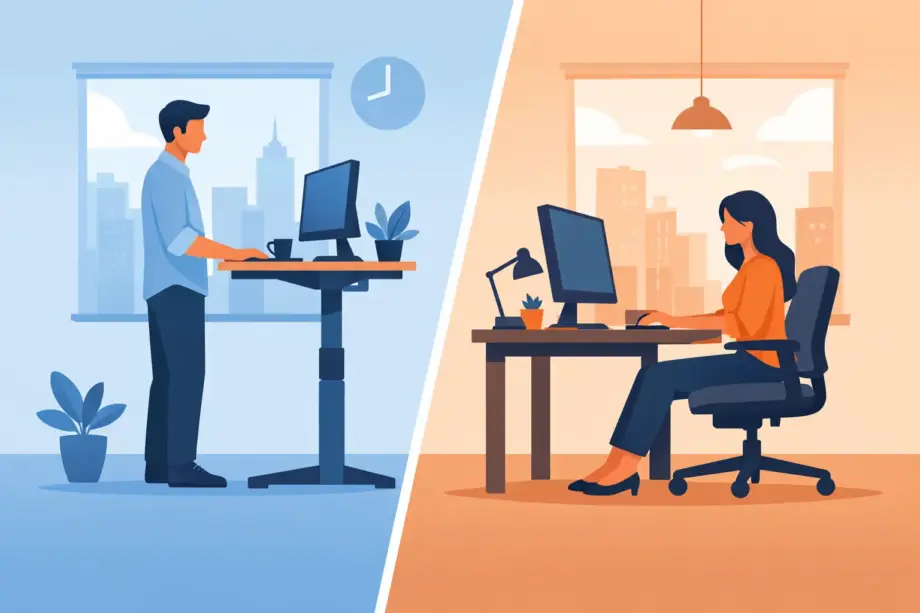
The biggest difference is not simply posture. It is movement. Sitting desks keep users in a stable, familiar working position, which suits focused computer work and longer administrative tasks. Standing desks encourage more regular position changes, which can help break up sedentary time and reduce that heavy, sluggish feeling that builds over a full day at a screen.
That said, standing all day is not the goal. A poorly planned standing setup can be just as uncomfortable as a poor sitting setup. Users can end up with tired legs, sore feet and raised shoulders if the desk height is wrong or if they stay upright for too long. In practical terms, the comparison is often less about standing versus sitting and more about static work versus adjustable work.
For offices, call centres, studios and home workspaces, adjustability tends to be the real value. It gives different users more control and helps a workstation suit more than one task across the day.
When sitting desks make better commercial sense
Sitting desks remain the standard for good reasons. They are straightforward to specify, easy to place across open-plan layouts and generally more budget-friendly when fitting out larger teams. If your staff spend most of the day on keyboard-heavy tasks, phones, accounts or admin work, a fixed-height desk paired with a quality ergonomic chair can still deliver a strong result.
They also suit environments where consistency matters. In shared offices, education settings and back-of-house administration areas, sitting desks can simplify procurement and keep workstation planning uniform. There are fewer moving parts, less adjustment required and often less training needed for staff to use them properly.
From a fit-out perspective, sitting desks can be easier to coordinate with pedestal storage, fixed monitor arms and cable management. If the priority is reliable performance, clean lines and efficient rollout across multiple workstations, they are often the practical choice.
The trade-off is obvious. If people remain seated for extended periods without moving much, comfort tends to drop off. Even with a good chair, too much time in one position is rarely ideal.
Where standing desks earn their place
Standing desks are especially useful in workplaces trying to improve flexibility and staff wellbeing without redesigning the entire floor. Height-adjustable workstations allow users to alternate between sitting and standing through the day, which can help reduce fatigue linked to prolonged sitting.
They can also suit teams with varied work patterns. Someone moving between emails, video calls, paperwork and short collaborative check-ins may benefit from being able to change posture throughout the day. In management offices and professional home setups, adjustable desks often add a premium feel while offering clear functional value.
For design-conscious commercial spaces, standing desks can support a more contemporary office aesthetic as well. Clean frames, integrated cable control and streamlined tops make them a strong option where appearance matters alongside performance.
Still, there are practical considerations. Electric sit-stand desks usually cost more than fixed desks. They need power access, and in some layouts that affects cable planning. In high-density offices, the movement range of the desk can also influence monitor setup, divider placement and overall workstation spacing.
Ergonomics matters more than desk type
A well-selected desk can only do so much if the setup around it is poor. In the standing desks vs sitting desks debate, ergonomics is what decides whether the workstation performs well over time.
With sitting desks, chair support is central. Seat height, lumbar support, arm positioning and monitor level all need to work together. If the desk is correct but the chair is wrong, discomfort shows up quickly.
With standing desks, users need the screen at eye level, elbows close to 90 degrees and wrists in a neutral position. They also need permission to sit down again. That sounds obvious, but many people treat a standing desk like a challenge rather than a tool. The better approach is to alternate positions based on task and comfort.
Anti-fatigue mats, monitor arms and cable accessories can also improve the result. For procurement teams and office managers, this is worth remembering. The desk itself is only one line item in the ergonomic outcome.
Cost, durability and rollout considerations
For a single office, the price gap between desk types may be manageable. Across a 20-person, 50-person or 100-person fit-out, it becomes a more serious budget conversation.
Sitting desks generally offer the lowest upfront cost and the fastest path to a uniform office setup. They are a dependable choice for broad rollout, especially where headcount is stable and desk use is predictable. Commercial-grade models also tend to be highly durable, particularly in fixed workstation environments where wear points are limited.
Standing desks involve higher initial spend, particularly electric models, but they can offer stronger long-term flexibility. If your business supports hybrid staff, shared desks or evolving team structures, an adjustable desk may reduce the need to reconfigure workstations later. One desk can suit a wider range of users, which is valuable in hot-desking and multi-user environments.
Durability should still be assessed carefully. Commercial settings need stable frames, reliable lifting mechanisms and surfaces that hold up under daily use. A cheap adjustable desk may look appealing on paper but create maintenance issues later. For business buyers, warranty support and stock reliability matter just as much as the feature set.
Which desk suits which work environment?
There is no rule that says an office must commit fully to one or the other. In fact, mixed-desk planning often works best.
Sitting desks are well suited to high-volume administrative areas, reception back offices, education rooms and teams that need simple, efficient workstation layouts. They are also a sensible choice where budget control is the first priority.
Standing desks are a strong fit for executive offices, creative teams, professional home offices, hot-desk zones and workplaces investing in staff experience. They can also work well as a targeted upgrade rather than a full-office change, especially when used for specific roles or shared focus stations.
For many buyers, the most commercially sound option is a blended approach. Fixed-height desks across the bulk of the team, paired with selected sit-stand workstations in shared areas or for staff who benefit most from adjustability. That keeps the fit-out balanced without overcomplicating the budget.
How to choose between standing desks vs sitting desks
Start with the work, not the trend. If the role involves long periods of concentrated screen time with minimal movement, a sitting desk with proper ergonomic support may be the smarter investment. If the role is more varied, or if users strongly value posture changes during the day, a sit-stand solution can offer measurable day-to-day benefits.
Then look at the physical environment. Ceiling services, cable runs, monitor arms, storage placement and available power all influence how practical an adjustable desk will be. In tight layouts, those details matter.
Finally, think about the lifespan of the fit-out. A desk is not just a purchase for this month. It is part of how your team works for years. Choosing commercial-grade furniture that supports both the look and operation of the space usually delivers better value than buying to the lowest spec.
At Furniture Pro Australia, that is often the real procurement decision – not simply which desk style is fashionable, but which option helps the workspace run better from day one and keeps performing as the business grows.
The best desk is the one people will actually use well. If your team can work comfortably, move when needed and stay productive through the day, you are already making the right call.