



Which Cafe Tables Resist Weather Outdoors?
A table that looks sharp on opening day can quickly become a maintenance problem after a summer of UV, salt air, rain and daily wipe-downs. For venue operators asking which cafe tables resist weather, the answer is not one material alone. It is the right combination of tabletop, base, finish and placement for the conditions outside your door.
A covered Melbourne laneway, a beachfront deck on the Gold Coast and an exposed pavement dining area in Perth place very different demands on furniture. Commercial outdoor tables need to keep their colour, stay stable, withstand frequent cleaning and continue presenting your venue well through busy service. Choosing for the environment first prevents premature replacement costs later.
Which cafe tables resist weather most effectively?
For most Australian hospitality settings, powder-coated aluminium, stainless steel, compact laminate and commercial-grade polypropylene are the strongest weather-resistant choices. They each handle moisture well, require relatively little upkeep and suit high-turnover dining areas. The best option depends on sun exposure, coastal conditions, your desired aesthetic and how often tables will be moved, stacked or cleaned.
Timber can also perform outdoors, but it requires a higher level of care. It is best selected where its warmth is central to the venue design and where staff can maintain the finish. Natural stone, terrazzo and concrete-look tops can create a premium setting, although their weight, porosity and base requirements need careful consideration.
Powder-coated aluminium: the practical all-rounder
Aluminium is a popular choice for outdoor cafe tables because it does not rust, is light enough for staff to reposition and works across modern, casual and coastal fit-outs. A quality powder-coated finish adds colour and a protective layer, allowing operators to coordinate tables with chairs, umbrellas and exterior branding.
Not all powder coating performs equally. For an exposed space, look for commercial-grade construction and a finish designed for outdoor use. Chips should be touched up promptly, particularly around table edges and feet, because damage can affect the appearance even where the aluminium beneath remains corrosion-resistant.
Aluminium tables are especially useful for flexible dining layouts. A lightweight frame and a stable base make it easier to reset a terrace for group bookings, function service or changing weather. In windy locations, however, a very light table may need a heavier base or a more sheltered position.
Stainless steel: ideal when hygiene and durability lead
Stainless steel table bases and frames offer a clean, professional look and stand up well to regular commercial cleaning. They are a strong option for cafes where tables move between indoor and outdoor zones, or where a sleek contemporary finish suits the design brief.
The grade matters. Stainless steel is corrosion-resistant, not corrosion-proof. In most urban outdoor environments, quality stainless steel is highly durable. For beachfront venues and poolside dining, marine-grade 316 stainless steel is the safer choice because salt in the air can cause tea staining and corrosion on lower grades over time.
Stainless steel works particularly well beneath compact laminate, timber-look or stone-style tops. Check that drainage around the base is adequate and avoid allowing water to pool under footplates. Regular rinsing is worthwhile in coastal areas, where airborne salt settles on furniture even when it has not rained.
Compact laminate: a high-performing tabletop for hospitality
Compact laminate is one of the most capable materials for cafe tabletops exposed to changing weather. Made from layers of resin-treated paper compressed under high pressure, it has a dense, non-porous surface that resists moisture, stains and everyday food-service wear.
Its main advantage is consistency. A compact laminate top does not need oiling like timber and is less likely to absorb spills. It is available in timber, marble, concrete and solid-colour looks, helping venue managers create a considered design without selecting a high-maintenance natural surface.
For fully exposed areas, inspect the tabletop edges and underside as closely as the upper surface. A purpose-made outdoor compact laminate top should be paired with fittings that allow for movement in heat, rather than being fixed in a way that encourages warping or stress around screws.
Polypropylene: efficient for casual outdoor settings
Commercial-grade polypropylene tables are a sensible choice for high-volume cafes, clubs, courtyards and poolside spaces. They are easy to clean, lightweight and generally unaffected by rain. Many designs can be paired with matching chairs for a cohesive, practical outdoor furniture package.
The trade-off is visual character. Polypropylene can look refined in the right design, but it may not deliver the same premium feel as a compact laminate top on a metal base. Constant harsh sunlight can also fade lower-quality products, so UV-stabilised commercial furniture is worth prioritising for open-air settings.
Weather resistance is more than the tabletop
A weather-ready top can still fail as part of a poorly specified table. Before ordering, assess the full construction. The base should suit the size and weight of the top, particularly for round tables and larger shared dining formats. A narrow or lightweight base beneath a heavy top creates instability, while an oversized base can interfere with chair placement and foot traffic.
Outdoor table bases need practical details: adjustable feet for uneven pavers, corrosion-resistant fittings, welded or well-engineered joints, and surfaces that are easy to wipe down. In a busy venue, the table also has to survive staff moving it across tiles, decking or concrete several times a day.
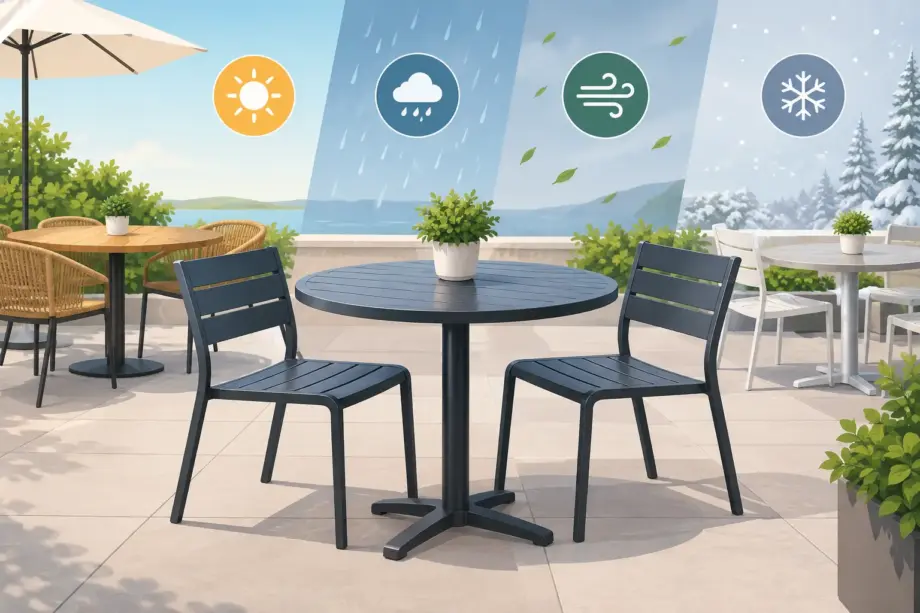
Consider the way water leaves the table. Slatted designs can shed rain quickly, while flat surfaces may retain water after a shower. This is not always a reason to avoid a flat tabletop, but it does affect how quickly a dining area can be reset after wet weather. Undercover areas may support a broader range of materials, while fully exposed pavement dining calls for the simplest, most water-tolerant specification.
Match the material to your location
Australian conditions are rarely uniform. Intense UV can be as damaging as rain, and salt air can be harder on furniture than a regular downpour. A table suitable for a protected inner-city courtyard may not be the right choice for an oceanfront beer garden.
For coastal venues, favour aluminium, marine-grade stainless steel and compact laminate. Rinse frames and bases regularly to remove salt residue, and avoid untreated steel components. In hot, sunny locations, select UV-stable finishes and darker colours with care, as they can become uncomfortably hot to touch during peak afternoon service.
For covered alfresco areas, timber and veneer-look surfaces become more viable, provided they are protected from direct rain and maintained according to their finish. A retractable awning reduces exposure, but wind-driven rain still reaches many outdoor dining areas. Specify for the worst likely condition rather than the ideal one.
When timber is worth the maintenance
Timber tables bring texture and warmth that metal and laminate cannot completely replicate. They suit neighbourhood cafes, wine bars and hospitality spaces aiming for a natural, relaxed look. Hardwood and properly finished commercial timber can be used outdoors, but it is a commitment rather than a fit-and-forget purchase.
Sun can dry timber, rain can encourage movement, and repeated cleaning gradually wears down protective coatings. Staff need clear cleaning procedures, and the venue should plan for periodic oiling or refinishing. Timber is often best used under cover or in partially protected zones, with more weather-resistant tables handling the fully exposed seats.
This mixed-material approach can be commercially sensible. It gives your best visual tables to premium positions while keeping the high-exposure perimeter easy to maintain.
Buying for service, storage and replacement planning
The right outdoor cafe table should make service easier, not only look good in a styled photograph. Measure table heights against your chosen chairs, allow enough clearance between settings and confirm whether bases tuck under the top without obstructing guests’ knees. For small spaces, pedestal bases can improve seating flexibility; for larger communal tables, multiple supports may be needed to prevent movement.
Think about off-season storage and daily close-down too. Stackable or foldable table designs can reduce labour where furniture is brought inside each evening. Fixed tables may better suit a permanent courtyard, but they should still allow access for cleaning beneath and around them.
For commercial procurement, consistency matters. Choosing a range with stocked matching components makes it easier to add tables as trade grows or replace damaged pieces without disrupting the look of the venue. Furniture Pro Australia supplies commercial outdoor options designed to help venues balance presentation, durability and practical turnaround times.
A well-chosen outdoor table earns its place every day: it stays steady through a busy brunch, cleans down quickly after service and still looks right when guests arrive tomorrow. Start with the conditions your furniture must genuinely handle, then select the finish that gives your outdoor area the confidence to trade in every season.